




In April 2026 the edited volume, entitled “Activating European Citizens’ Trust in Times of Crisis and Polarization: Towards a New Era of Representative Democracy”, will be published by Springer. The work is edited by Prof. Dr. Michael Kaeding (Institute for Political Science, University of Duisburg-Essen), together with Prof. Dr. Daniela Braun (Department of European Social Research, Saarland University), Dr. Alexander Hartland (Department of European Social Research, Saarland University), Dr. Zoe Lefkofridi (Department of Political Science, University of Salzburg) and Dr. Kristina Weissenbach (Institute for Political Science, University of Duisburg-Essen).
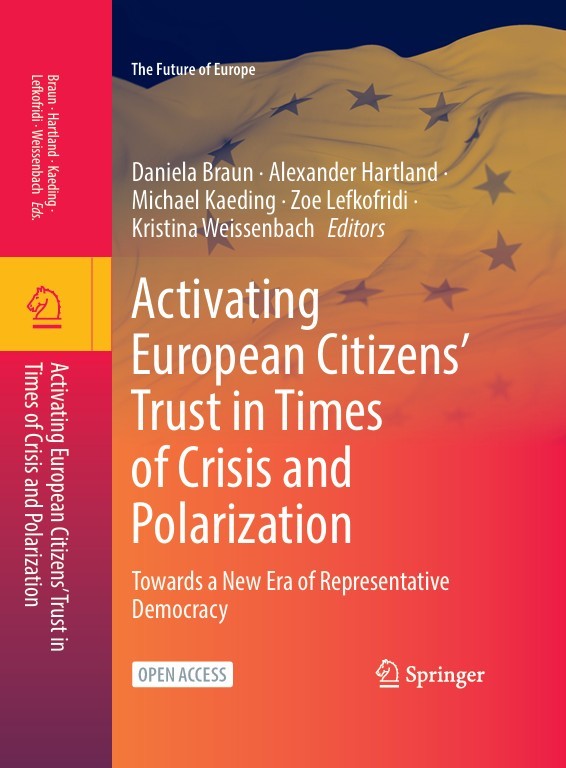
This open access book explains why representative democracies need political trust and legitimacy: Political trust is a crucial yet underestimated element in Europe’s representative democracies. A trusting relationship between citizens and the institutions of the state ensures the functioning of democratic systems, reduces transaction costs and facilitates the justification of political decisions. Without the commitment of a critical mass, democratic governments cannot gain legitimacy among the populace.
While a stable relationship of trust between citizens and the state through political parties is a prerequisite for representative democracies in normal times, it is even more important in times of significant democratic change and turmoil, i.e., when democracies are in flux. Accordingly, the contributions gathered here examine political trust and legitimacy in Europe using a new conceptual framework – the ActEU conceptual triangle, which draws on citizens’ political attitudes, their political participation, and the representation of their political preferences to map and assess the decline of political trust and legitimacy in Europe.
More information about the edited volume can be found here.